Offside causes more arguments in the stands than any other law. The basic idea fits in three lines. The fine points are where people get confused.
How we wrote it: we follow the text of Law 11 from the IFAB, the body that writes the laws. We checked the history and the technology against a second source, such as Wikipedia and FIFA. The sources are listed at the end.
The answer in three lines
- You are in an offside position when any part of your head, body or feet is in the opponents’ half and nearer to the goal line than both the ball and the second-last opponent.
- Being in an offside position is not an offence in itself.
- It becomes an offence only if, at the moment a team-mate plays or touches the ball, you then get involved in play.

What counts for position
The IFAB defines which body parts count. The head, body and feet count. The hands and arms do not, and that includes the goalkeeper’s. The upper limit of the arm is the bottom of the armpit.
The halfway line does not count against you. Someone level with it is in his own half. The law applies only in the opponents’ half.
If you are level with the second-last opponent, you are not offside. The same goes if you are level with the last two opponents. Usually the goalkeeper is the last opponent and the last defender is the second-last. But the law counts opponents, not positions.

When the position becomes an offence
The IFAB splits involvement in active play into three cases.
- Interfering with play: you play or touch a ball that a team-mate has passed or touched.
- Interfering with an opponent: you block his line of vision, challenge him for the ball, clearly try to play a close ball in a way that affects him, or make an obvious action that makes it harder for him to play the ball.
- Gaining an advantage: you play the ball after it has rebounded from the post, the crossbar, a match official or an opponent, or after it has been deliberately saved by an opponent.
Two details. If you take the ball from an opponent who deliberately played it, you do not gain an advantage. The exception is a deliberate save. A deliberate play means the player has control of the ball and could pass it, win it or clear it. A failed attempt counts too. A save is something else: the player stops, or tries to stop, a ball that is going into or very close to the goal.

When there is no offside
You cannot be offside if you receive the ball directly from:
- a goal kick,
- a throw-in,
- a corner kick.
There is also no offside in your own half.
One email a week
The numbers of the week, a Bet Maker idea and what is new. Unsubscribe anytime.
What happens after the whistle
The opposing team gets an indirect free kick, taken from the place of the offence. This applies even if the offence was in the player’s own half. If the attacker plays or receives the ball inside the goal area, the free kick can be taken from anywhere inside that area.
How the law has changed

Wikipedia records the main milestones.
- 17 November and 1 December 1863: the newly formed Football Association adopts a strict rule, with an exception for kicks from behind the goal line.
- February 1866: the three-player rule arrives. You are not offside if at least three opponents are between you and the goal line.
- 1907: you are not offside in your own half.
- 8 June 1925: the FA approves the two-player rule. The IFAB adopts it later the same month. According to Wikipedia, goals in the Football League rose from about 4,700 in 1924-25 to 6,373 in 1925-26, with the same number of matches. A second source, the Sports Journalists’ Association, confirms the figure of 6,373. The decision of 8 June 1925 is also described by the Woolwich Arsenal blog. The 4,700 figure comes from one source.
- 1990: an attacker level with the second-last defender is no longer offside, per Wikipedia. We found this in one source.
- 2005: the “interfering” wording is built into Law 11.
- 2016: the IFAB clarifies that a player on the halfway line is not offside.

VAR and semi-automated offside
With VAR, assistant referees hold back the flag on tight calls until the move has finished, according to Wikipedia.
Semi-automated offside technology (SAOT) went further. FIFA describes the system used at the 2022 World Cup in Qatar:
- 12 tracking cameras under the roof of the stadium.
- Up to 29 data points on each player’s body, 50 times a second.
- A sensor inside the Al Rihla ball, sending data 500 times a second, to find the moment of the pass.
The system alerts the video match officials when a player receives the ball in an offside position. They check the point of the pass and the line, and tell the referee. The decision remains human. The same data is then turned into a 3D image for stadium screens and television. The system was tested at the Arab Cup 2021 and the 2021 Club World Cup, as FIFA writes.


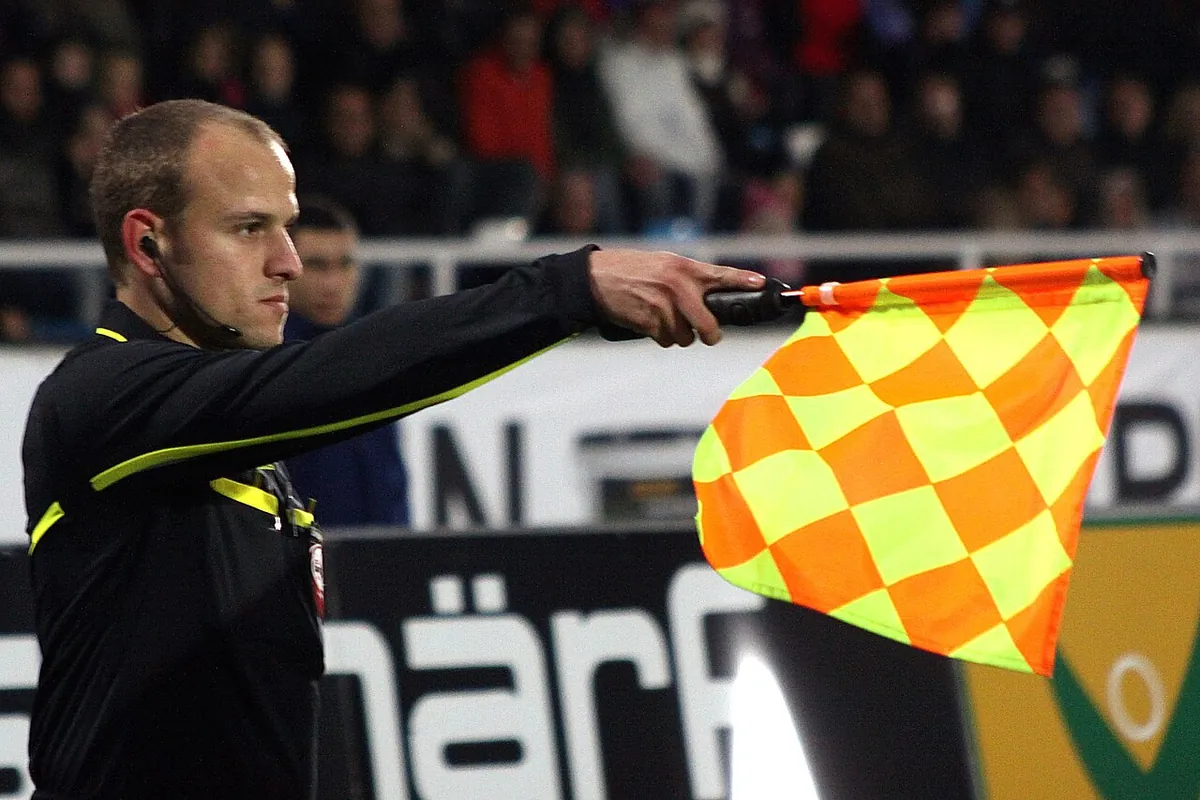


Offside checks today: a VAR screen, assistant referees with flags and the Lusail Stadium in Qatar
If you want to follow upcoming matches with data
On aigoallab.com we have match pages with form, starting line-ups, absences and probabilities for upcoming games. They show the numbers before a match. They do not promise profit, and no probability is a certainty.
Gamble responsibly. 21+.
FAQ
Is being in an offside position an offence? Not in itself. It becomes an offence when, at the moment a team-mate plays or touches the ball, you interfere with play, interfere with an opponent or gain an advantage.
Can I be offside from a corner, a throw-in or a goal kick? No. The law says there is no offside when you receive the ball directly from one of these restarts.
Do hands count for offside? No. The head, body and feet count. The hands and arms, even the goalkeeper’s, do not.
If I am level with the last defender, am I offside? No. Level with the second-last opponent, or with the last two opponents, you are not offside.
Sources
- The IFAB, Laws of the Game, Law 11 Offside: https://www.theifab.com/laws/latest/offside/
- Wikipedia, Offside (association football): https://en.wikipedia.org/wiki/Offside_(association_football)
- FIFA, Semi-automated offside technology: https://inside.fifa.com/innovation/world-cup-2022/semi-automated-offside-technology
- Sports Journalists’ Association, The season that it rained goals: https://www.sportsjournalists.co.uk/sports-digest/the-season-that-it-rained-goals/
- Woolwich Arsenal blog, 8 June 1925: the offside rule changed: https://blog.woolwicharsenal.co.uk/archives/24574
AI Goal Lab Team. Last updated: 10 November 2026. If you find a mistake, tell us and we will correct it.